La Rambla, Barcelona: How the Pickpocket and Scam Economy Actually Works
Look at the pedestrians in the middle of this frame. Almost every one of them is doing the same thing: standing still, looking up, hands empty or holding a camera, bag hanging off one shoulder and swung round to the back. That posture is the entire business model. La Rambla does not have a crime problem so much as it has a distraction industry, and the two are the same thing.
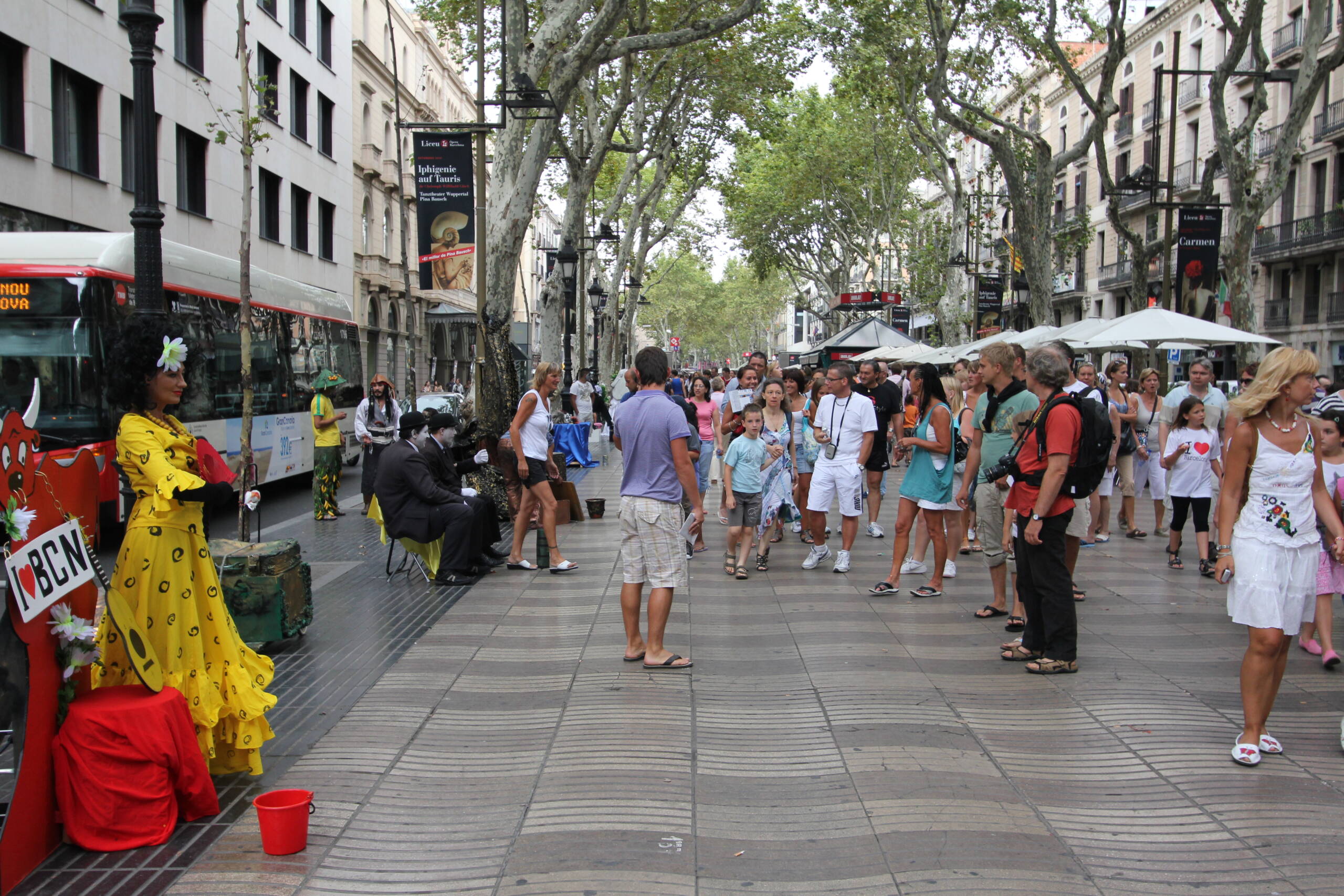
The living statues are the honest end of it. A flamenco figure in yellow with a sign reading I ♥ BCN, a pirate, two mimes painted the colour of old nickel, a gold man frozen against a plane tree. They work for coins in a bucket and they are not the problem. What they do is create a reliable stopping point in a river of moving people, which is exactly the condition a pickpocket needs. Somebody has to be standing still for a wallet to leave a pocket cleanly.
The physics of it
Pickpocketing on La Rambla is opportunistic and non-violent. Almost nobody gets hurt. That is worth stating plainly, because the reputation makes people imagine something more dramatic than what actually happens, which is that your phone leaves your back pocket while you are looking at a man dressed as a statue.
The crowd density does most of the work. Contact that would be alarming on an empty street reads as normal here. Someone brushing past you in a stream of four hundred people is not suspicious. That is the cover, and it is free.
Watch for the setups that manufacture contact:
The bump. Two people, one going each way, and you end up sandwiched for a second and a half. The second person is the one who lifts.
The stain. Something wet lands on your jacket or shoulder. Mustard, ice cream, something worse. A helpful stranger appears with a napkin and starts dabbing. You are now standing still with a stranger’s hands on you, which is a remarkable position to have talked your way into.
The dropped object. Coins scatter, or a bag spills. People bend down. So do you, because you are a decent person. Your bag swings forward and away from your body.
The petition. A clipboard, a cause, usually deaf-charity framing. You look down to read it. The clipboard is a screen and there is a hand under it.
The rose or the bracelet. Something is placed in your hand or tied to your wrist before you agree to anything, and then payment is demanded. Nothing gets stolen here. You are just being extracted from directly.
The shell game. Three cups, a ball, a crowd of enthusiastic winners who are all part of the operation. You cannot win. The game is not rigged in the sense of being hard, it is rigged in the sense of not being a game.
Where it concentrates
Not evenly along the street. The pressure points are the top end at Plaça Catalunya where people arrive with luggage and no bearings, the entrance to the Boqueria market where the crowd compresses into a bottleneck, the area around the Liceu metro stop, and the escalators and platforms of the metro itself. The port end near the Columbus monument thins out and the risk drops with it.
Terrace cafés on the street are their own category. A bag on the back of a chair is gone. A bag on the ground with a strap under your chair leg is not, and this is the single easiest habit to build.
What actually works
Front pockets only. A phone in a back pocket on La Rambla is a donation with extra steps.
Crossbody bag, worn in front, zip facing your body, hand resting on it whenever you stop walking. Not a fashion note, just a physical block.
Split your money. Some cash in one place, a card in another, and never all of it in a bag you set down.
Photograph your passport and cards before you travel, and keep the images somewhere you can reach without your phone.
Do not stop for the clipboard, the bracelet, the cups, or the person who tells you there is something on your shoulder. Keep walking and check yourself somewhere quiet.
If you are hit, report it. The Mossos d’Esquadra take reports online and at stations, and there is a tourist-focused station on La Rambla itself. You are unlikely to see the wallet again. You need the denuncia for insurance and for replacing documents, which is the real reason to bother.
Go anyway
The advice at the bottom of every article like this one tends to be avoid La Rambla, which is bad advice. It is a plane-shaded kilometre running from a city square to the sea, it has the Boqueria and the Liceu opera house on it, and it is one of the great walking streets in Europe. The scams are the tax on a place that works too well.
Walk it. Keep your hands on your bag when you stop to watch the statue. Give the statue a coin, because the statue is the only one on the street who told you what the deal was.