The Dance at Stephansplatz: What European Identity Actually Looks Like
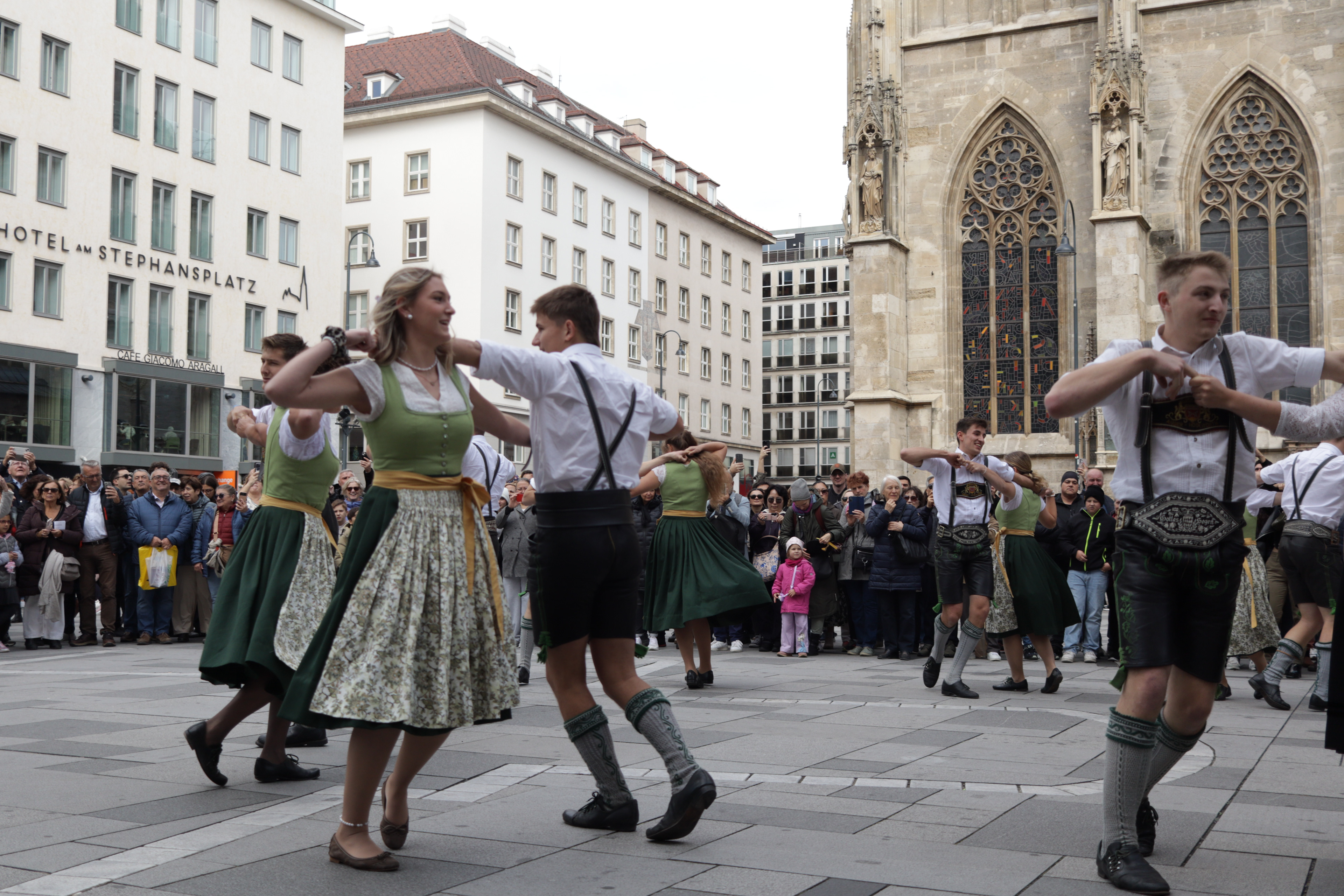
At the foot of St. Stephen’s Cathedral in Vienna, young dancers in Dirndl and Lederhosen perform a traditional Austrian folk dance on the cobblestones of Stephansplatz. Tourists and locals form a dense ring around them. A small girl in a pink jacket watches from the crowd. The Gothic spire rises behind them, eight centuries old, unmoved.
This is a scene that repeats across Europe — staged, yes, but not hollow. The staging is precisely the point.
Tradition as a live argument. European identity is not a policy document. It is not a Brussels directive or a common currency or a set of shared economic interests, though it encompasses all of these. At its core, it is a claim about continuity — that something persists through time, through rupture, through the assaults of uniformity that modernity brings with it. The folk dance at Stephansplatz is a performance of that claim. The performers know they are asserting something. So does the crowd.
The particularity problem. The debate about European identity consistently runs into the same structural difficulty: Europe is not one thing. Austrian Volksmusik is not the same as Breton festou-noz dancing, which is not the same as Flamenco, which is not the same as Greek rebetiko. What holds these together under a single identity rubric is not content but form — a shared insistence that the particular matters, that the local is worth preserving, that the pressure toward a flat, globalized monoculture is a loss rather than a gain.
This is what distinguishes European cultural nationalism, at its best, from ethnic nationalism. The former says: our specific dances, foods, languages, and festivals have value and should survive. The latter says: people unlike us should not. The distance between these positions is immense. They are routinely conflated by those who prefer the conflation.
Vienna as an argument. Stephansplatz is not an accidental venue. Vienna is where the Habsburg Empire administered a multi-ethnic, multi-linguistic civilization for centuries. It is where Klimt, Freud, Wittgenstein, and Mahler produced work within blocks of each other. It is a city that has been destroyed, occupied, divided, and rebuilt. The cathedral behind the dancers survived Ottoman siege, Napoleonic occupation, Allied bombing, and Soviet presence. That it still stands is not a given. It required choices — about what to protect, what to restore, what to pass forward.
The dancers in front of it are making the same kind of choice. Wearing traditional costume in a city center in 2026 is an act of deliberate transmission. It says: this belongs to us, we are giving it to the next generation, we expect them to give it to theirs.
The audience question. What is striking about the photograph is the crowd. It is mixed — tourists with cameras, elderly Viennese, families with children, people who look like they stopped to watch on their way somewhere else. Nobody is being compelled. The dance is freely given and freely received. This is the transaction that makes culture durable: not law, not mandate, but voluntary inheritance.
European identity will not be settled by political debate about what it means to be European. It will be reproduced or lost in precisely these moments — a square, a crowd, a dance that everyone present understood well enough to stop for.
The Gothic arches are not going anywhere. The question is whether anyone will keep dancing beneath them.