Notre-Dame de Fourvière's West Front: The Basilica Lyon Built Because the Prussians Stopped Short
In 1870 the Prussian army was moving through eastern France and Lyon expected to be next. The archbishop, Jacques Ginoulhiac, made a public vow: if the city were spared, Lyon would build a church on the hill for the Virgin. The Prussians got as far as Nuits-Saint-Georges and stopped. Two years later the first stone went in, paid for by subscription, and the city spent the next twenty-four years honouring a promise made under panic.
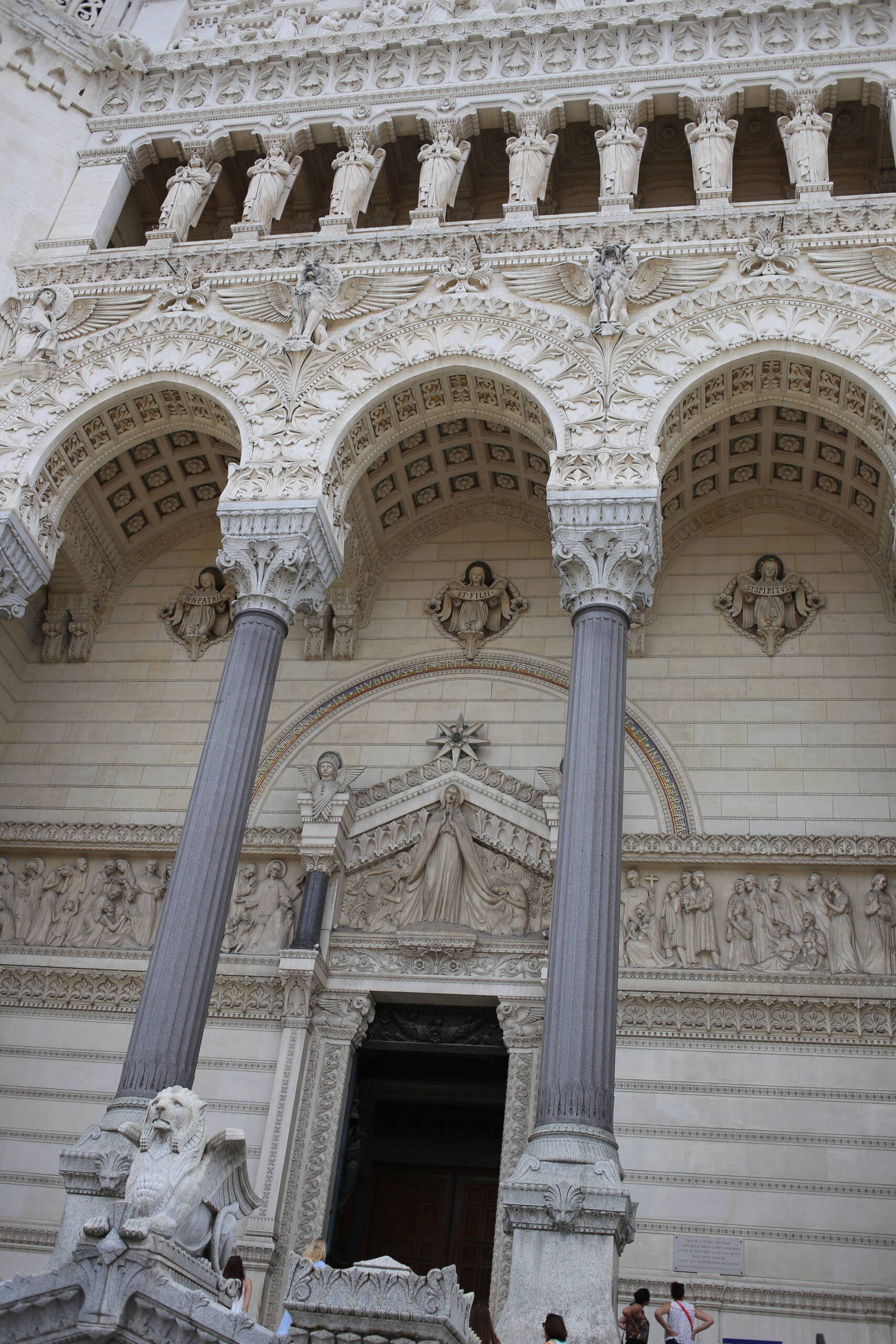
What Lyon got for its money was not a normal church. Pierre Bossan, the architect, was a local man with an unusual set of obsessions. He worked from the Book of Revelation and from the visions of María de Ágreda, a seventeenth-century Spanish nun, and he treated the building as an argument rather than a shelter. Nothing on this façade is filler. Every band of carving is making a point, and the points connect.
A fortress that isn’t defending anything
Start with the shape. Four octagonal towers, forty-eight metres, crenellated. The two on the west side facing the parvis stand for fortitude and justice, the two on the city side for prudence and temperance. Cardinal virtues, dressed as battlements.
The military language runs all the way down. The gallery of standing figures under the pediment is a row of angels serving as caryatids, carved by Paul-Émile Millefaut, and they are holding swords. Millefaut made them thick and short-limbed because they genuinely carry the weight of the pediment above, but the effect is a garrison on the parapet. The open gallery behind them lightens what would otherwise be a blank slab of wall, which is the practical reason it exists, but Bossan clearly liked the way it reads.
Lyon was not amused at the time. The building picked up the nickname “the upside-down elephant,” four legs in the air, and the joke stuck for decades.
The portal is an argument about Mary
The three arches carry the tetramorph in their spandrels, the four evangelist symbols spread across the front: the eagle, the lion, the ox, the winged man.
Beneath them sit three medallions, each an angel unrolling a scroll, and the scrolls carry the baptismal formula split one clause to an arch. In the name of the Father. And of the Son. And of the Holy Spirit. You read the façade left to right and you have said the Trinity.
Then the doorway, which is where Bossan gets specific. The bronze doors show Noah’s ark and the Ark of the Covenant. Both are traditional Old Testament types of Mary, the vessel that carries what saves. The relief bands flanking the portal continue in the same key, drawing on stories of daughters delivered or vindicated. Above the doors, a plaque of the men who commissioned the thing, cardinals in a row, with Bossan among them holding a drawing of the building.
The lion with folded wings at the base of the stairs is not decoration either. It guards the way down into the crypt, which is dedicated to Joseph. Bossan’s plan was that pilgrims should enter through the dark lower church and come up into the bright one, reaching Mary by way of her husband. The route is the theology.
What it cost and what it became
Bossan’s health failed before the work was done and his student Louis Sainte-Marie Perrin took over the site, following the drawings. The last stone went in around 1884. Consecration came in 1896, and the church was raised to basilica the following year. Sculptors kept working on it long after that, with Joseph Belloni alone giving it more than twenty years.
Early in the twentieth century, with anticlerical feeling running high, a mayor of Lyon floated the idea of closing it to worship. Nothing came of it. In 1998 the hill went onto the UNESCO list along with the rest of historic Lyon, and Fourvière now takes millions of visitors a year, most of whom come up the funicular for the view over the city and find the view back at the building harder to shake off.
It is a strange, dense, slightly airless piece of work. It is also completely coherent, which is rarer.