Why the House Edge Always Wins and the Venice Casino Still Nearly Closed
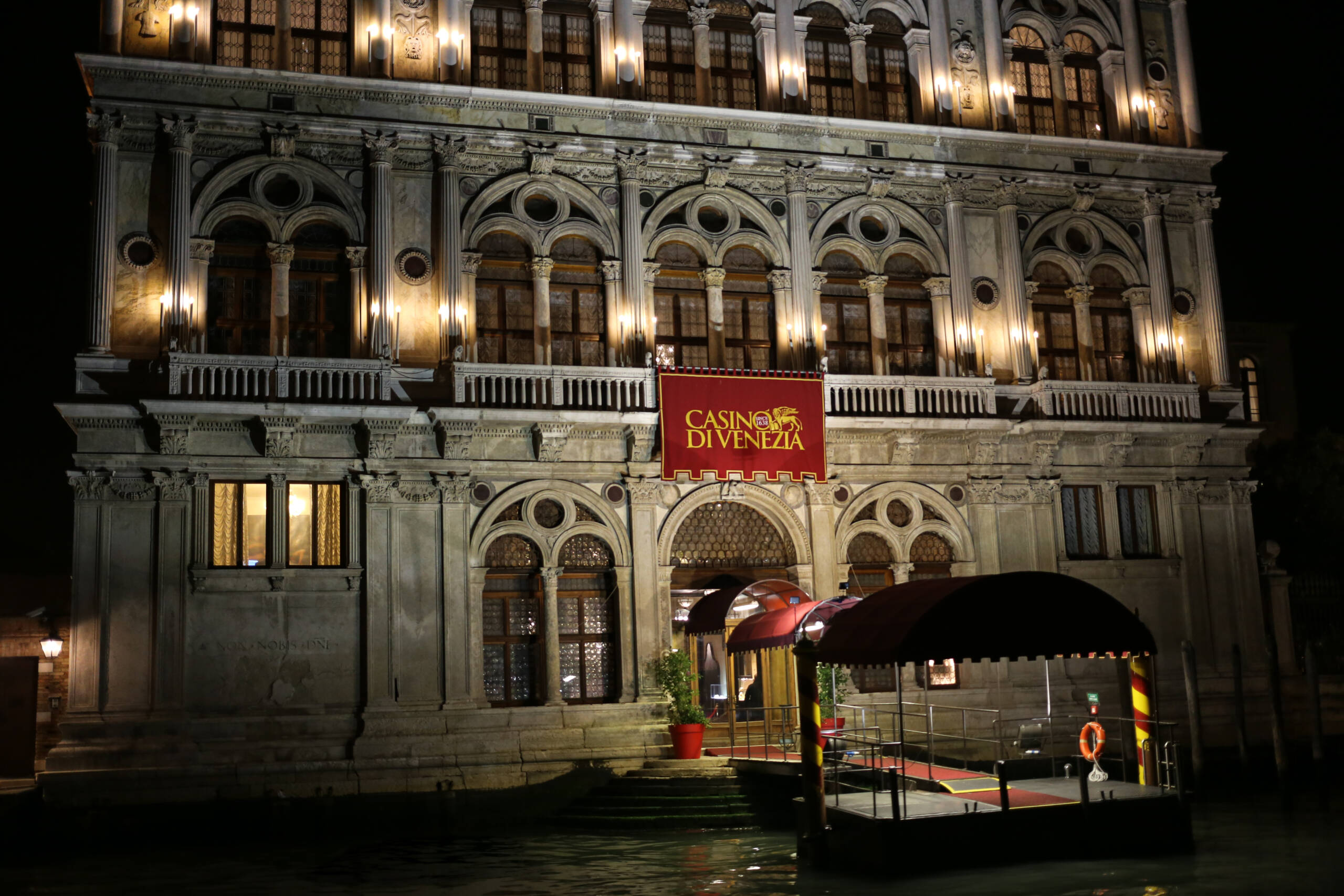
The building is a Renaissance palace on the Grand Canal, lit up at night, with a red banner hung over the balustrade advertising the games inside. You arrive by boat. There is a floating pontoon, an awning, a strip of red carpet leading to the door. Nothing about the approach suggests a business with a mathematical guarantee attached to it, which is exactly the point.
The guarantee is real, though, and it is embarrassingly simple. Take European roulette. The wheel has 37 pockets. Bet a single number, win, and the table pays you 35 to 1. True odds are 36 to 1. The house keeps the difference on every settled bet, which works out to 2.7% of everything wagered. The American wheel adds a second zero, 38 pockets, same payout, and the edge doubles to 5.26%.
Notice what that is not. It is not the casino winning more spins than you. The croupier pushes chips across the table all night; plenty of people at that table are up. The edge lives entirely in the payout schedule, in the gap between what the game costs and what it pays. Nobody has to cheat, and nobody has to get lucky.
Volume converts probability into certainty
Here is where the asymmetry gets interesting. The player and the house face the same distribution; they do not face the same sample size.
You will play a few hundred spins in an evening, maybe a few thousand across your life. At that count, variance dominates. You can walk out ahead, and a fair number of people do, which is what keeps the room full. The casino plays millions of spins a year across every table on the floor. At that count, variance collapses toward the mean, and the mean is 2.7% of turnover. What is a gamble for you is a fixed-margin revenue line for them, forecastable to a decimal point.
Bankrolls finish the job. You have a wallet with a floor in it; the house effectively does not. Run any simulation of two players betting against each other with wildly unequal stacks and the smaller stack goes to zero eventually, even with no edge at all, purely because it can hit zero and the other one cannot. Give the larger stack a 2.7% advantage on top and the question stops being whether, it becomes when.
The product is time
If the edge applies per bet, then revenue is the edge multiplied by the average stake, multiplied by bets per hour, multiplied by hours played. Three of those four terms are about duration.
That reframes the whole building. Chips instead of cash, because chips do not feel like money. No windows, no clocks. Drinks at the table. Slot machines that resolve in three seconds so the bets-per-hour term stays high. A casino is not selling you odds, it is selling itself your time on the device, and every design decision in the room is downstream of that arithmetic.
So the maths never fails. Which raises the question of how the oldest casino in the world managed to end up on the edge of liquidation.
The edge is not the business
By 2015 the Casinò di Venezia was running a deficit of around €2.5m with roughly €1m of cash on hand. Net equity went negative in 2016. The city was looking at closing or selling it, and there were years of union disputes, court cases and a unilateral restructuring before the thing stabilised.
Gross gaming revenue across Italy’s four municipal casinos had fallen from about €550m in 2007 to around €290m by the early 2020s. A smoking ban in 2005 pushed players outside; licensed online gambling arrived in 2011 and took the volume home. Meanwhile the payroll stayed, and so did the palace, which is a fifteenth-century structure sitting in salt water that needs constant work whether anyone is playing or not.
The house edge guarantees a gross margin on wagers. It guarantees nothing about footfall, staff costs, competition, or the maintenance bill on Mauro Codussi’s stonework.
Venice solved it by moving the money. Ca’ Noghera, out near Marco Polo airport, takes about 700,000 players a year, roughly ten times the palace on the canal, which now opens at weekends and functions largely as a piece of ceremony. The casino paid the city €26m in 2024 and expects close to €30m for 2025.
The edge was never the thing in doubt. What was in doubt was whether anyone would still show up at a palace to lose to it.