The Broken Noses on Egyptian Statues Were Not an Accident
Walk the Egyptian rooms of any big museum and after a while you notice it. The noses are gone. Not every one, but enough of them that luck stops being a satisfying answer.
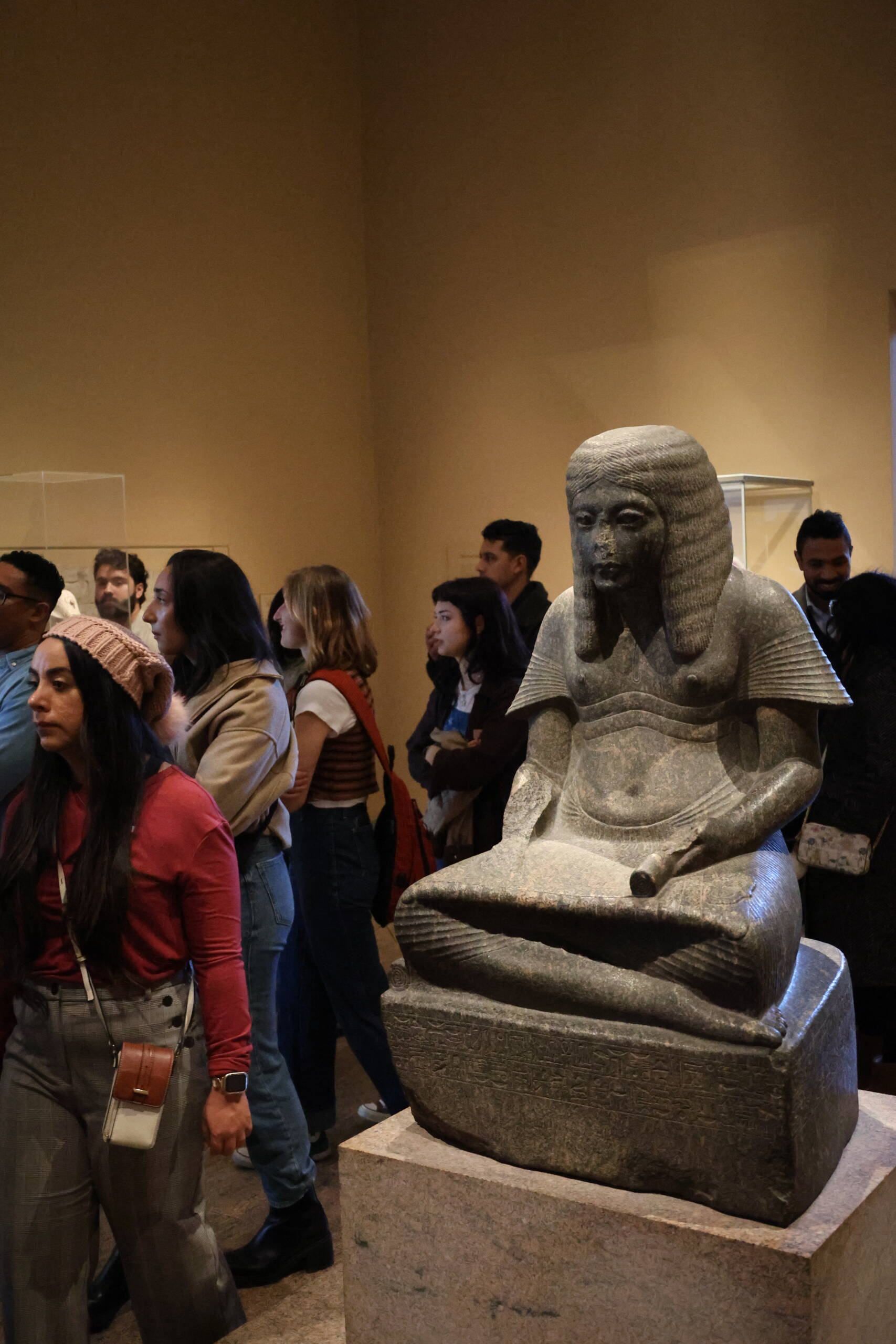
Here is a seated official in dark stone, hands resting on his folded knees, heavy wig falling either side of a face that somebody worked over. The crowd moves past him without stopping. One woman has her phone out; she is photographing something else.
The usual explanation is mechanical. A nose sticks out from a face, so it takes the hit when a statue topples, gets crated badly, spends a few centuries face-down in sand. Reasonable enough. It falls apart the moment you look at flat carving.
Two-dimensional reliefs have damaged noses too. On a relief the nose is a shallow ridge, a couple of millimetres proud of the wall, with nothing to snap off. Somebody had to bring a chisel to the wall, find the face, and go at that specific ridge. That is a decision, made by a person, who walked in with a tool.
What a statue was for
We file these things under sculpture, which is where the misunderstanding starts. This was not decoration, or portraiture in our sense. A statue was a house.
The Egyptian dead needed somewhere for the ka to live, a place it could return to when the body failed (which bodies do, mummification notwithstanding). Priests performed a ceremony over the finished figure to open its mouth, and after that the thing was live. It breathed. It heard prayers spoken in the courtyard. It received bread, beer, cuts of meat, either physically laid on the offering table or supplied through the formula carved into the base, which worked just as well if anyone stopped bringing the actual food.
So the object had organs. It had a working respiratory system, an ear for petitions, a left arm for making offerings and a right for taking them.
Now the damage makes sense as a pattern rather than a mess. Break the nose, the ka suffocates. Chip off the ears, prayers stop arriving. Take the arms and the figure can neither give nor receive, which cuts it out of the economy of the dead entirely. Scrape the name from the base and there is nobody left to address. The vandalism is precise, and it is precise in the same places across three thousand years of material.
Who was swinging
Successors, for one. A new king with a shaky claim went through the monuments of the old one; Hatshepsut’s images came down under Thutmose III, Akhenaten’s under everyone who followed. Later religious movements did their own rounds. There was ordinary spite, too, the local kind, aimed at a rival family’s tomb.
The best of the culprits are the tomb robbers.
Think about what robbing a tomb required, if you believed what your culture told you about tombs. You are stealing from a man who is watching you, whose statue is standing right there, animated, capable of noticing. The robbers dealt with this the practical way. They disabled him first. Smash the nose, then take the gold, because a suffocated ka cannot follow you home.
Which is the part I keep turning over. The mutilation is not evidence that people had stopped believing in the power of these objects. It is evidence that they hadn’t. You do not bother killing something you think is already inert. Every flattened face in that gallery is a testimonial, left by someone who was frightened enough of a piece of granite to bring a hammer.
The gallery now
We have our own version, and it is thinner. Accounts get deleted, footage gets pulled, names come off buildings. It takes a few seconds and leaves nothing behind, no chisel marks, no half-finished job where somebody was interrupted.
The Egyptians built their memory system out of the hardest stone they could quarry, on the assumption that the threat to a man’s name was time. It wasn’t. It was the next man with a grievance and an afternoon free.
He is still there in the gallery, breathing through nothing, waiting for the offerings. The crowd files past.