The AI Capex Value Chain: Twelve Tiers From Chip to Software Revenue
Every dollar of AI capital expenditure eventually lands somewhere concrete: a wafer, a switch, a cooling loop, a power purchase agreement, a SaaS seat. Tracking that flow from the hyperscaler earnings call down to the individual equity ticker is the only way to separate durable exposure from sentiment-driven noise. The chain below runs twelve tiers deep rather than the usual eleven, because the packaging layer that sits between memory and networking has become too structurally important to leave folded into a generic equipment bucket.
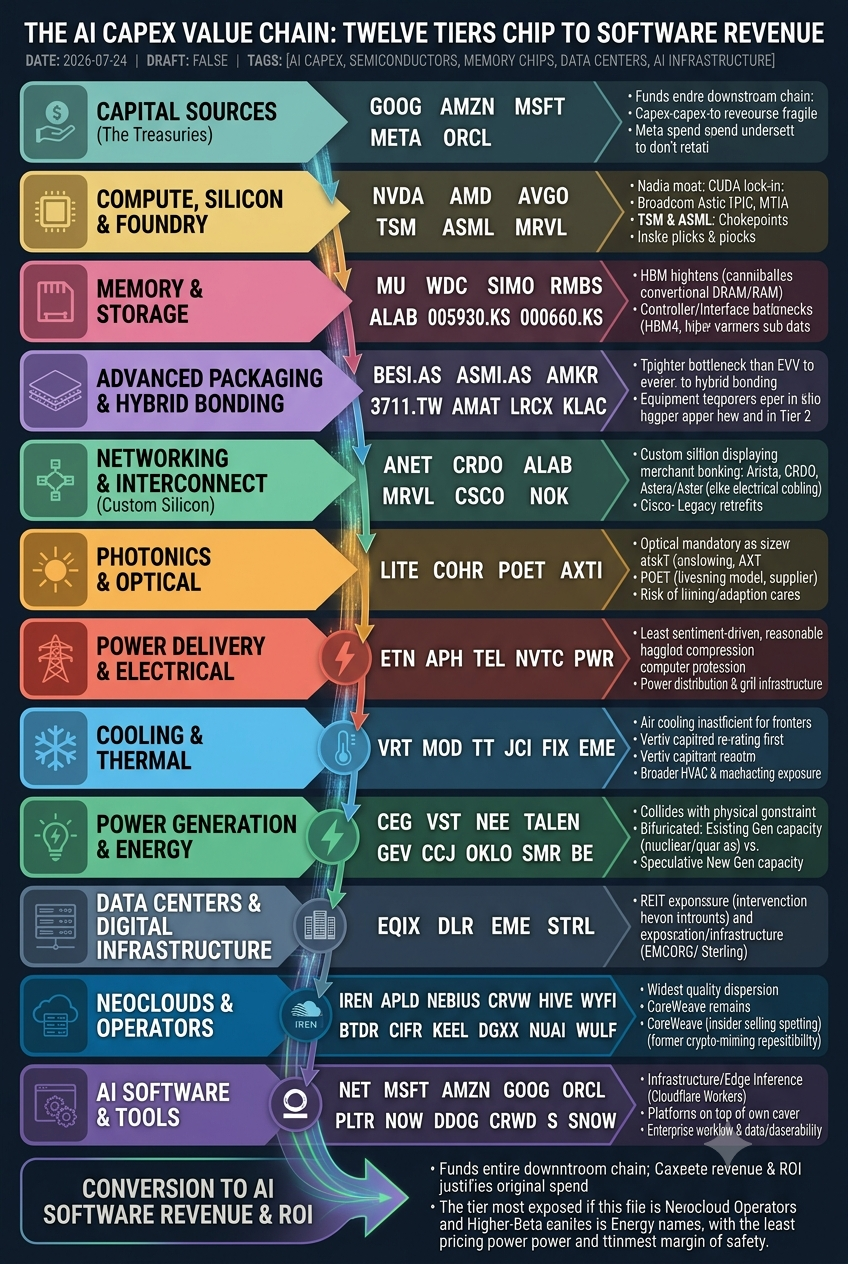
The first tier is the source of the capital itself. Alphabet, Amazon, Microsoft, Meta, and Oracle are not AI companies in the traditional sense — they are the treasuries funding the entire downstream chain, and their combined capex guidance is the single number that moves every other tier on this list. Oracle is the outlier of the group: a legacy enterprise software vendor that re-rated on the strength of RPO backlog tied to GPU-as-a-service contracts rather than its core database franchise, which makes its capex-to-revenue ratio the most fragile of the five. Microsoft and Amazon carry the deepest moats because their capex is cross-subsidized by existing hyperscale margins; Meta’s spend is the hardest to underwrite because it has no cloud rental business to recover the cost, only an internal productivity thesis.
The second tier is compute, silicon, and foundry — the layer everyone already watches too closely. Nvidia’s moat is CUDA lock-in, not the silicon itself, and that distinction matters more with every passing quarter as AMD’s MI-series closes the raw performance gap. Broadcom is arguably the better-hidden story here: its custom ASIC design revenue with hyperscalers doing their own silicon (Google’s TPU line, Meta’s MTIA, and reportedly others) has a longer revenue tail than merchant GPU sales because those contracts are structurally sticky once a customer has taped out a design. TSM and ASML are the tier’s chokepoints — TSM as the only foundry that can print at the advanced nodes GPU designs require, ASML as the only supplier of the EUV lithography tools TSM needs to do it. Marvell sits at the bottom of this tier on the cheat sheet but deserves to be read as its own thesis: the Nvidia convertible preferred stake, the Teralynx T100 switch silicon, the Celestial AI and XConn acquisitions, and the custom silicon design wins collectively make Marvell the clearest expression of “picks and shovels inside the picks and shovels” — a company that profits from hyperscalers building their own chips rather than buying Nvidia’s.
The third tier is memory, and it is the tier most mispriced relative to its structural tightness. HBM production consumes DRAM wafer capacity at a ratio dramatically worse than conventional DRAM, which means every additional gigabyte of HBM shipped to Nvidia or AMD cannibalizes conventional DRAM and NAND supply that was never expanding fast enough to begin with. Micron is the cleanest US-listed HBM expression; SanDisk is the cleanest pure-NAND expression following its spinoff, and its valuation math increasingly gets compared to Samsung and SK Hynix on a per-wafer basis rather than to its own trading history. The controller and interface sub-layer — Silicon Motion, Rambus, Astera Labs, and Marvell again — is where the actual bottleneck often sits, since HBM4 and next-generation DDR standards require interface IP that only a handful of vendors have qualified. Samsung and SK Hynix carry the added complication of being non-US-listed exposure with their own capital allocation and currency risk layered on top of the memory cycle itself, which is a reasonable basis for treating them as a distinct, higher-variance sub-bet rather than a simple substitute for Micron.
The fourth tier is the one the original chip-to-software framing tends to bury inside a generic “equipment” bucket: advanced packaging and hybrid bonding. This is where HBM stacks actually get assembled, and it is arguably the tightest physical bottleneck in the entire chain, tighter even than EUV capacity. BE Semiconductor Industries and ASM International, both listed on Euronext Amsterdam, are the two purest hybrid bonding plays as the industry transitions away from traditional micro-bump packaging toward direct copper-to-copper bonding for HBM4 and beyond — a transition that is less discussed than the GPU story but arguably has a longer runway because it is a physics constraint, not a demand constraint. Amkor and ASE round out the traditional outsourced assembly and test layer, while Applied Materials, Lam Research, and KLAC supply the deposition, etch, and metrology tools that both the packaging houses and the foundries depend on — the rare case of a single equipment vendor appearing credibly in two separate tiers of the same value chain.
The fifth tier is networking and interconnect, where the thesis has shifted from “Nvidia sells the switch too” to “custom silicon is displacing merchant switching.” Arista remains the incumbent with the deepest hyperscaler relationships, but Credo and Astera Labs are the higher-beta expression of the same trend that is powering Marvell’s custom silicon story — active electrical cabling and retimers that solve the specific problem of GPU cluster interconnect at scale. Cisco and Nokia are legacy telecom names retrofitted into this tier more by necessity than by genuine AI-native positioning, and their inclusion says more about the breadth of AI infrastructure spend than about either company’s competitive position.
The sixth tier, photonics and optical, is where the packaging bottleneck reappears in a different form: as cluster sizes grow, electrical interconnect runs into physical distance limits and optical becomes mandatory rather than optional. Lumentum and Coherent are the scale incumbents; POET Technologies and AXT are the higher-conviction upstream bets — POET on its optical interconnect licensing model, AXT as the InP substrate supplier that photonics manufacturing depends on further upstream. The risk in this tier is timing rather than thesis: co-packaged optics adoption curves have been pushed out before, and a name like AXT can be right on the substrate thesis while still being late relative to when the stock already priced in the move.
The seventh tier, power delivery and electrical, is the least sentiment-driven part of the chain and arguably the safest place to have exposure precisely because nobody trades it as an AI story. Eaton, Amphenol, TE Connectivity, nVent, and Quanta Services sell power distribution equipment and grid infrastructure that data centers need regardless of which GPU vendor wins the compute layer, which makes this tier a reasonable hedge against compute-layer multiple compression.
The eighth tier, cooling and thermal, has gone from a footnote to a load-bearing thesis in under two years as GPU thermal density made air cooling insufficient for frontier clusters. Vertiv is the name that captured this re-rating first and most completely; Modine, Trane, Johnson Controls, Comfort Systems, and EMCOR are the broader HVAC and mechanical contracting exposure that benefits from the same buildout without carrying Vertiv’s now-elevated multiple.
The ninth tier, power generation and energy, is the tier where the AI capex story collides hardest with physical grid constraints, and it is also where the thesis has bifurcated most sharply. Constellation, Vistra, NextEra, Talen, and GE Vernova represent the “AI demand meets existing generation capacity” trade — largely nuclear and gas assets re-rated on data center power purchase agreements. Cameco, Oklo, NuScale, and Bloom Energy represent the more speculative “new generation capacity built specifically for AI load” trade, and the dispersion in balance-sheet quality and regulatory timeline across that group is far wider than the “power stocks” label suggests.
The tenth tier, data centers and digital infrastructure, is REIT exposure rather than technology exposure, and should be sized accordingly. Equinix and Digital Realty are the interconnection-heavy incumbents; EMCOR and Sterling round out the construction and infrastructure-buildout side rather than the landlord side, which means grouping them with EQIX and DLR understates how different their revenue models actually are.
The eleventh tier, neoclouds and operators, is the tier with the widest quality dispersion on the entire sheet. IREN, Applied Digital, Nebius, CoreWeave, and HIVE are the core group — GPU cloud operators monetizing compute directly, with balance sheet and contract-quality differences between them that matter more than the sector label implies. CoreWeave in particular deserves scrutiny on insider selling activity relative to its growth narrative. The “emerging/higher beta” cohort — WYFI, Bitdeer, Cipher, Keel, DGXX, NUAI, WULF — is largely former crypto-mining infrastructure repositioning toward AI hosting, and the repositioning is a genuine option on AI demand only to the extent the underlying power contracts and site infrastructure are actually convertible to GPU hosting rather than marketing language layered onto stranded mining capacity.
The twelfth and final tier is AI software and tools, and this is where Cloudflare belongs even though it rarely makes the standard capex cheat sheets built around the hyperscaler-plus-SaaS framing. Cloudflare’s edge network, Workers AI inference platform, and R2 storage give it a genuine claim to the inference-and-delivery layer of the stack rather than just a security-vendor label, and its moat is closer to Marvell’s than to Salesforce’s: infrastructure that becomes more valuable as inference workloads move closer to the end user rather than staying concentrated in hyperscaler regions. Microsoft, Amazon, Google, and Oracle reappear here as platform layers on top of their own capex; ServiceNow and Palantir are the enterprise AI-workflow monetization story; Snowflake, MongoDB, Datadog, and CrowdStrike round out the data-and-observability layer that every AI deployment eventually needs regardless of which model or chip underlies it.
The chain reads cleanest top to bottom as a capital flow — hyperscaler capex funds silicon, silicon funds packaging and memory, packaging and memory fund power and cooling buildouts, and the whole stack eventually has to convert into AI software revenue that justifies the original spend. The tier most exposed if that final conversion disappoints is not compute — it is the neocloud operators and the higher-beta energy names, since both groups carry the least pricing power and the thinnest margin of safety if hyperscaler capex guidance ever actually decelerates.